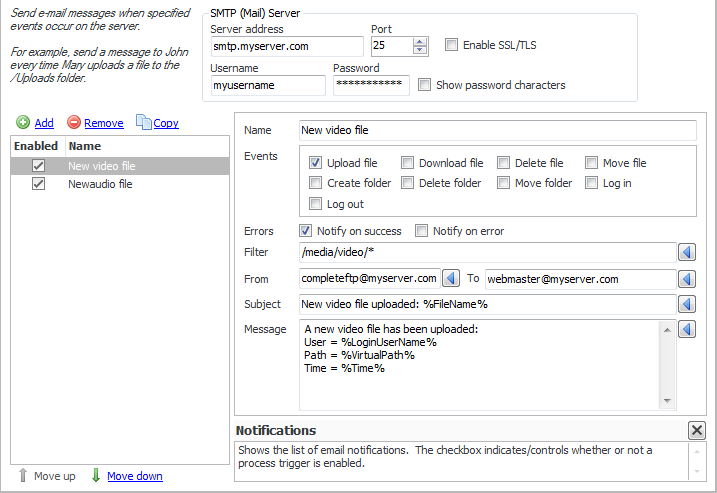
CompleteFTP supports highly customizable email notifications. This means that when an event such as a file upload occurs, an email can be sent.
To set up email notifications, the mail server (SMTP server) settings must be entered. The server hostname, port number (normally port 25) and optional username and password are entered in the Email Notification tab found from the Events panel. SSL connections are also permitted by checking the "Enabled SSL/TLS" checkbox. For SSL, the port number will most likely need to be changed - the default SMTP SSL port is 465.
The list of current notifications is displayed in the Email Notification tab. Use Remove to delete notifications, and Add to create a new notification.
Enter an appropriate name for the notification, and select what Events the notification is applicable for. The various fields are described below.
Processes may be triggered by any of the types of events listed below. By default events are only triggered when an operation, such as a file upload, succeeds, but they may also be triggered on failure. This is determined by the checkboxes labelled 'Trigger on success' and 'Trigger on error'.
The folder- or file-path filter should be entered. This filter may be used to select the files/folders
which the notifications should be sent for. For example, if notifications should only be sent for
files with the extension, '.dat', then the filter should be set to '*.dat'. By default Windows-style wildcards are
used for matching.
Note that the full path is used for matching; not just the file-name. So
if notifications should be sent for files named 'test.dat' in any directory, then the filter
should be set to '*/test.dat'.
Regular expressions .NET-style) may also be used. To use these the filter should be prefixed
by 'regex:'. Information on .NET regular expressions may be found on the Microsoft(tm) website.
Note that multiple filters may be defined using regular expressions using the syntax,
regex:^(/Folder1/.*|/Folder2/.*), which would match anything underneath the folders,
/Folder1 and /Folder2. If you want to match anything not underneath
these folders you can do that using the regular expression, regex:^(?!/Folder1/.*|/Folder2/.*).
Enter the email address that the email notification is set to be from. The %OwnerEmail% (email address of folder owner) or %LoginEmail% (email address of logged-in user) macros may be used here.
Enter the email address that the email notification is sent to. The %OwnerEmail% (email address of folder owner) or %LoginEmail% (email address of logged-in user) macros may be used here.
Enter the subject of the notification message. Various macros can be used here.
Enter the body of the notification message. Various macros can be used here.